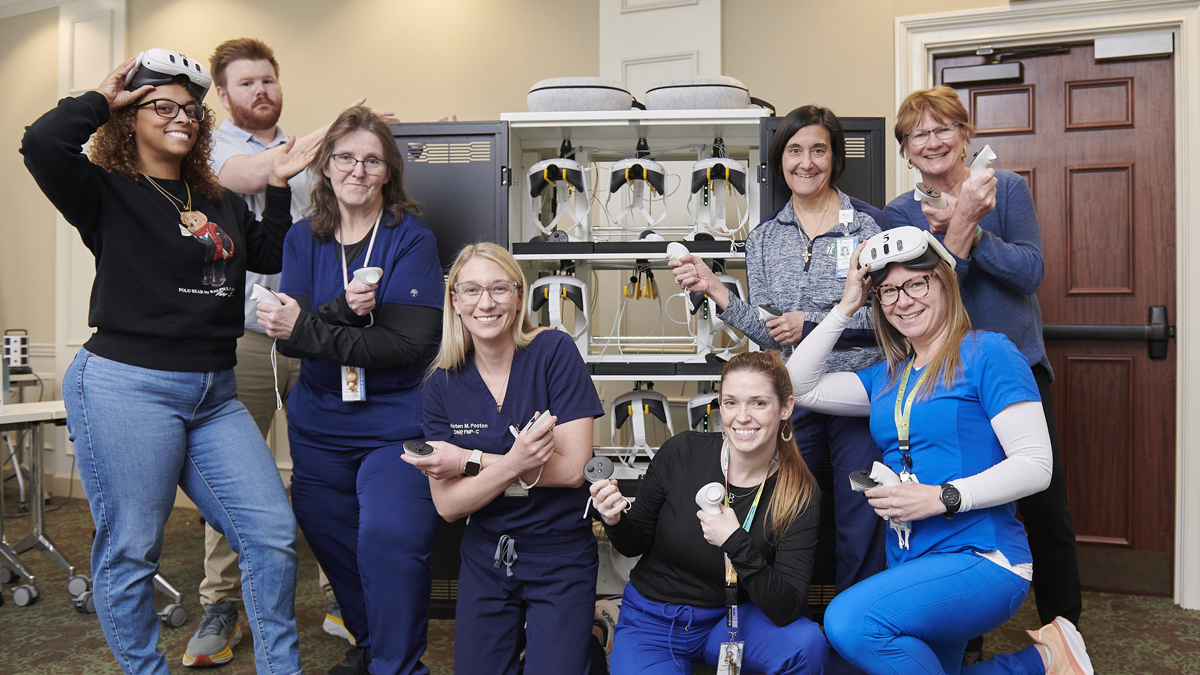


Virtual Reality Revolutionizes Nursing Education at MUSC
As if nursing school isn’t stressful enough. Your mistakes could hurt someone. Thinking quickly on your feet takes on a whole new meaning when you are still trying to learn. And then there is the blow to your confidence when someone more experienced and seasoned notices that you cracked under pressure.
Cue the new virtual reality curriculum as part of the Accelerated Bachelor of Science in Nursing (ABSN) program at the Medical University of South Carolina. Nursing students now have a chance to dive into high-stakes scenarios, make mistakes safely and build confidence before stepping into real-world clinical practice.
Transforming Clinical Training Through Immersive Simulation
The Immersive Virtual Reality Simulation (IVRS) curriculum revolutionizes how the ABSN program trains its students. The College of Nursing became one of the first in South Carolina to offer an advanced IVRS-based curriculum in fall 2024, boosting clinical judgment and practice readiness among pre-licensure nursing students through emerging simulation technology that evaluates competency. Nine training scenarios begin in the first semester and span four semesters of the program.
Brandi Townsend, BSN, RN, simulation coordinator for MUSC’s ABSN program, explained, “We aim to collaborate with hospital stakeholders to identify and address competency gaps before graduation through a strategically developed VR curriculum—analyzing feedback from hospital partners and data from graduate nurse experience surveys, then using these insights to refine the IVRS curriculum map.”
Collaboration and Innovation in Training
The integration of IVRS allows for flexible, accessible simulation training, overcoming barriers such as limited faculty availability, clinical space and geographic location. The College of Nursing had not previously used virtual reality technology. To prepare for launching the curriculum, faculty and staff trained with the Oxford Medical Simulation team.
“So far, the feedback has been overwhelmingly positive,” Townsend said. “Faculty members value the practicality and efficiency that virtual reality provides, while students welcome the innovative technology and have potentially formed new friendships throughout the process.”
In a recent collaboration with the College of Pharmacy, nursing and pharmacy students jointly operated within a virtual workroom to manage a patient diagnosed with hyperkalemia and acute kidney injury.
Preparing Students for Real-World Scenarios
Special focus is given to leadership, care coordination and communication skills. Teaching styles include classroom instruction, online learning and hybrid activities. Students are expected to engage actively in all formats.
Those enrolled in the ABSN degree program must earn 121 semester hours on a full-time basis. Clinical experiences take place across inpatient, outpatient and community settings in the greater Charleston area, primarily at sites near the MUSC campus.
The College of Nursing uses best-practice simulation to provide a safe environment for developing psychomotor and critical thinking skills. Simulation experience bridges classroom theory with real-world clinical application.
“It has been very rewarding to see students participate with enthusiasm and learn from each other, and we look forward to more collaborations in the future,” Townsend said.
Addressing the National Nursing Shortage
According to the American Nurses Association, nursing job opportunities will outpace all other professions in the coming years, with the U.S. Bureau of Labor Statistics projecting demand for more than 275,000 additional registered nurses in the next decade.
The IVRS curriculum offers students hands-on clinical experience in a virtual environment that mirrors real-world patient care. Through immersive simulations, students navigate complex patient scenarios, work within interprofessional teams and refine communication skills—building confidence in handling high-stress situations and better preparing them for transition to practice.
The ABSN degree spans four consecutive semesters, including summer, and is an on-campus program with classroom, lab and clinical components. The curriculum focuses on the knowledge, skills and values essential for professional nursing practice in today’s health care system. Graduates are prepared to work in hospitals, community agencies, clinics, long-term care facilities and private practices.
While demand for nurses continues to rise, the shortage of registered nurses remains a critical challenge. Accelerated BSN programs like MUSC’s are helping bridge that gap by providing a faster pathway to a nursing degree, attracting diverse candidates and addressing specialized workforce needs across the country.
For more information on the ABSN program at MUSC, visit nursing.musc.edu/admissions/our-programs/accelerated-bsn.
By Theresa Stratford